
Performance & Networking
One machine per person,
one network per department.
Each machine holds its own drawing library — and can be queried by teammates.
Drawings never leave the machine; only answers travel across.
Multi-Machine Networking
Drawings stay put; answers flow.
Every EX is both a querier and a responder — it can ask others and be asked in return. Whether to open up, and which drawings to share, is decided by each owner on their own machine.
What crosses machines is the answer plus a screenshot of the exact spot — never the drawing file itself. Both the requesting and the queried side keep a full trail.
There is no central node and no server needed to pool every drawing in the company. Each machine builds and holds its own library independently; machines transfer no files and call on each other only at query time.
Each machine ships with TB-scale storage and holds a complete library of its own, so networking is never limited by the capacity of a single node. The queried machine must be online when you query it. Currently sized for single-department deployments.
On-Device AI Inference
Here are the numbers.
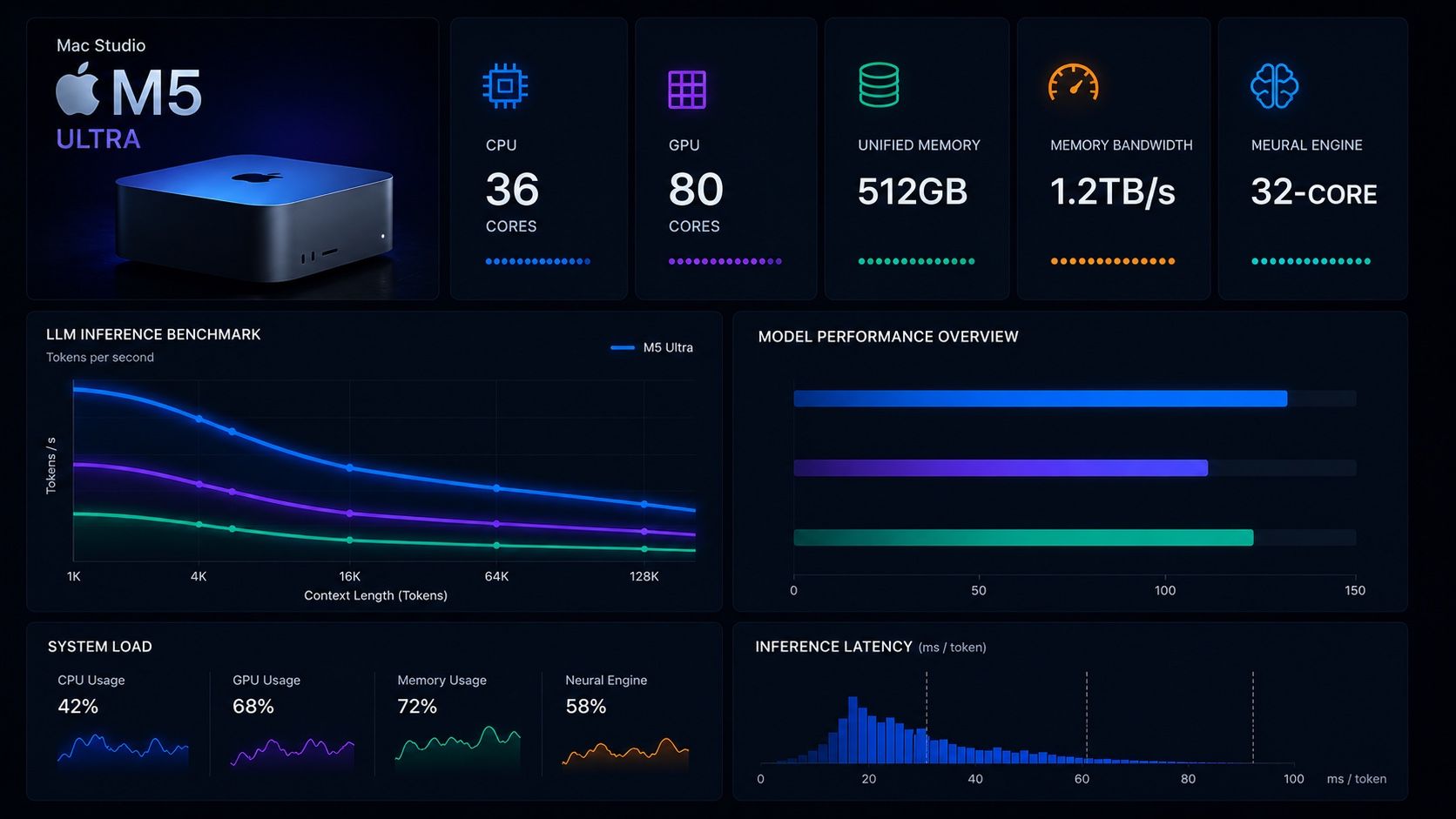
Measured values for single-user use, based on factory-standard configuration. Unified memory decides how large a model the machine can hold, how much context it can cache, and how many drawings it can store.
| Scenario | Context | First-token latency | Generation speed |
|---|---|---|---|
| One-line question | ~100 chars | 2.1 s | 79.7 tok/s |
| Single-document Q&A | 1k | 2.3 s | 83.9 tok/s |
| Multi-document comparison | 4k | 3.4 s | 85.1 tok/s |
| Long-document read-through | 8k | 4.1 s | 83.7 tok/s |
| Context ceiling | 30k | 8.8 s | 83.8 tok/s |
Measured data, single stream, single user, model kept resident in memory. Test unit: EX-512-3 (M3 Ultra · 512 GB unified memory), default configuration.
Two Models
Fast — or stronger.
EX-512-3 ships with two AI models preloaded. Daily retrieval runs on the default configuration — faster, and more than enough for drawing work. For questions that need reasoning across multiple documents, switch to the 480B mixture-of-experts model and trade speed for capability.
Both models stay resident in memory; switching requires no reload.
| Default configuration | 480B MoE configuration | |
|---|---|---|
| Best for | Daily retrieval, single-document Q&A | Cross-document reasoning, complex synthesis |
| Models | EX-96-3 / EX-512-3 | EX-512-3 only |
How the Two Models Differ
Memory decides how smart it gets.
Unified memory is more than storage — it also decides how large an AI model can be loaded, how many models can stay resident, and how much context can be cached.
| EX-96-3 | EX-512-3 | |
|---|---|---|
| Unified memory | 96 GB | 512 GB |
| Preloaded models | Mid-size model covering the full drawing-retrieval feature set | Mid-size model + 480B-parameter mixture-of-experts (MoE) model |
| Resident models | Single model resident | Multiple models resident at once — no reload when switching |
| Context cache | Standard | Larger cache — more headroom for long context and follow-up questions |
| Library capacity | 100k+ pages | 100k+ pages · 4× storage headroom |
| Storage | 1 TB | 4 TB |
| Chip platform | M3 Ultra | M3 Ultra |
Model Upgrades
This machine gets better with use.
A model management tool is built in — copy new model files in and load them directly. Stronger open-source models arrive every few months; no need to wait for our release, swap them in yourself.
None of this requires an internet connection — just bring the model file in.
Library Building
How long until your archive is in?
A single machine holds a drawing archive of 100k+ pages. Building the library is a one-time effort, done in batches — the first batch is usually recent, frequently queried drawings, ready to use within a week or two, with the rest added incrementally as needed.
What decides the build speed is whether each page needs block-by-block recognition — vector documents with a text layer are read directly, while scanned drawings require recognizing every annotation, a fourteen-fold difference.
You only build your own share. Networking does not split one archive across machines — each machine builds and holds the library it is responsible for, and together they cover the whole department. No one has to build a library for everyone else.
The table below estimates how long your archive will take. One week of continuous running is 168 hours.
| Page type | Time per page | Per hour | One week nonstop |
|---|---|---|---|
| Engineering drawings, scansAnnotations recognized block by block | 29.6 s | ~120 pages | ~20k pages |
| Regular documentsVector format with a text layer — no recognition needed | 2.1 s | ~1,700 pages | ~280k pages |
Figures are conservative estimates and vary with page complexity. Builds can run overnight and on weekends without occupying work hours; the first build is completed and accepted on site by our engineers. Retrieval latency barely changes with library size — querying 10k pages feels the same as 100k.
Want to see it run live?
Connect to a real machine remotely and run any test above on the spot.